Don't Trust the Reel. Read the Record.
Retail investors deserve the same facts as the big money.
Om Prakash Choudhary · 7 November 2026
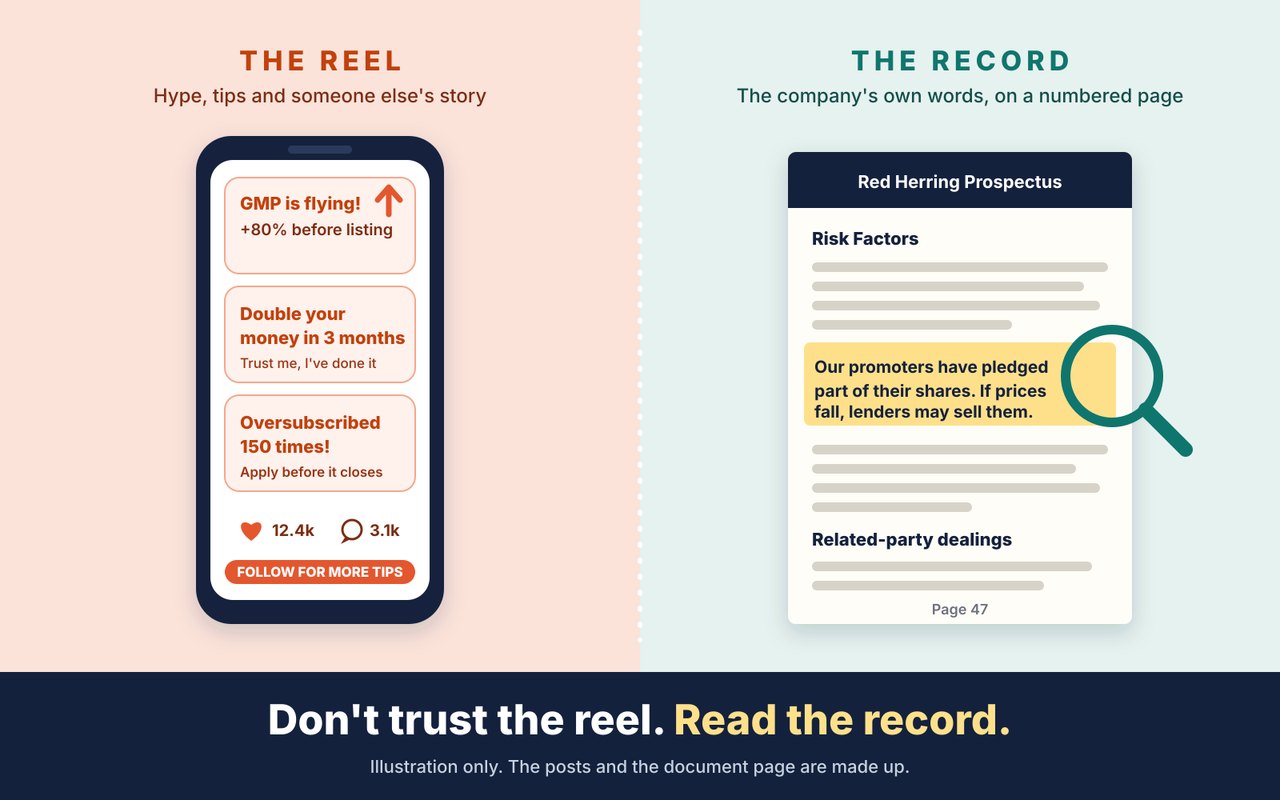
Many retail investors in India don't lose money because they're careless. They lose it because they decide on someone else's story instead of the company's own facts.
Open any social media feed and the story is the same. This share is "the next big thing". This IPO is "oversubscribed many times over", and its grey market premium is "flying". A short video promises that your money could double in a few months. For someone saving hard from a monthly salary, that promise is very hard to ignore.
The trouble is that almost none of these stories send you to the one place where the company must, by law, tell the truth: the documents it publishes itself.
The herd: at the IPO window and beyond
The herd is at its loudest in the three days an IPO is open for bids. The number of applications is updated every hour, and each update pushes more people to apply. The same thing happens with shares that are already listed: a tip goes viral, and thousands of people buy the same share in a single day.
Much of this hype is built on the grey market premium (GMP). Before a share lists, some dealers trade it unofficially, outside the stock exchange, at a price above the IPO price. That extra amount is the "premium", and it is shared widely as a sign of how much the share will gain on listing day. But the grey market is not regulated by SEBI. Nobody has to stand behind these prices, a handful of traders can push them up, and they can vanish overnight. A high GMP is not a promise, and it is not information from the company.
SEBI, the market regulator, has studied this. It looked at 144 IPOs that listed between April 2021 and December 2023. More than half of the shares given to investors (54%) were sold within one week of listing. When a share rose more than 20% in its first week, individual investors sold about two-thirds of their shares. When it fell, they sold less than a quarter. In other words, many people buy an IPO only to sell it quickly, and they hold on to the ones that lose money.
SEBI has also acted on where much of this noise comes from. In August 2024 it stopped brokers and other regulated firms from working with people who give share tips without being registered. It has also had more than 15,000 pieces of content by such "finfluencers" (financial influencers) taken down. The noise is still there, but it is now easier to spot.
Why "just ask AI" is not enough
There is a proper way to judge the risk in a company. You read the company's own document: the risks it lists, its accounts, its related-party dealings (business it does with its own promoters, their families or their other companies), the court cases against it, and how it plans to spend the money it raises. These documents often run to hundreds of pages. Few working people have the time, or the training, to read them.
AI tools look like a shortcut, and they do help. But if you let an AI search the whole internet and decide for itself what to believe, it can mix up two companies, use an old figure, repeat someone's opinion as fact, or even make up a number. And it says all of this just as confidently. If you can't see where an answer came from, you can't tell whether it is right.
The sites use AI too, but only on the company's own documents, and every answer shows the page it came from.
What the big investors do differently
Large investors, such as mutual funds and insurance companies (part of the group known as QIBs), and the "anchor investors" who buy just before an IPO opens to the public, don't decide based on social media. They pay teams of analysts and advisers to read the documents page by page. These teams tell them whether to buy or sell and, just as important, when.
SEBI's study shows the difference. Mutual funds sold only about 3% of their IPO shares in the first week after listing. Their decisions follow research, not the day's headlines.
Ordinary investors don't have such a team. That is the gap that needs closing.
The remedy: start with the company's own words
The answer is simple. Get the facts from the company itself, and read them properly.
Before an IPO, a company files a draft document with SEBI, called the DRHP, and later the red herring prospectus (RHP), published before the issue opens. Once listed, it publishes annual reports and regular updates to the stock exchange. The company stands behind what these documents say and can be held to account for them. If the promoters have pledged their shares, if there is a big court case, or if profits are falling, it is written there on a numbered page. Anything you hear online can be checked against that page. If it isn't there, be careful.
One idea, three sites: before listing, abroad and after listing
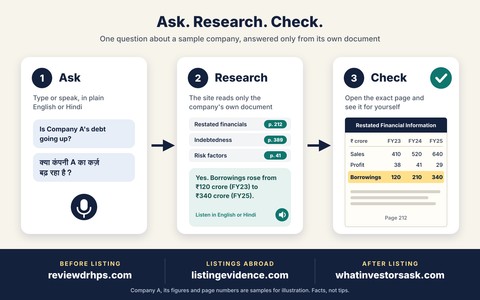
That is why I built three sites, one for each stage:
- Review DRHPs: Indian companies planning an IPO, from the draft document (DRHP) to the red herring prospectus (RHP).
- Listing Evidence: companies listing on markets abroad, such as the US and UK.
- What Investors Ask: companies that are already listed.
Why trust them? Because every answer takes you to the exact page in the company's own document where the company stated that fact. You don't have to take the site's word for it. Click through and read the page yourself.
They are also built for the way people actually ask questions:
- Ask in plain English or Hindi. Type a question the way you would ask a friend, and get an answer that shows you the page it came from.
- Speak, and listen. Ask your question out loud in English or Hindi, and hear the answer read back in either language.
- Facts, not tips. The sites don't tell you to buy or sell, and they don't give ratings or price targets. They show you what the company has said, so the decision stays yours.
See the company's story in pictures
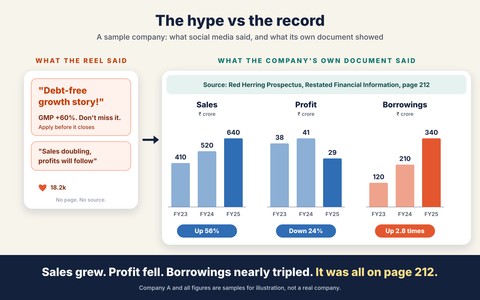
Numbers in a long document are hard to follow. So the sites also turn the company's own figures into simple visual stories: sales, profit, borrowings and cash over the years, side by side. At a glance you can see whether sales are growing while profit is falling, or whether the company is borrowing more each year to keep going. Every chart names the document and page its figures come from, so you can check them yourself. The charts show what happened, not what will happen; they are not a forecast or a tip.
Priced only to cover costs
Retail investors can use these sites at a very reasonable cost. The pricing aims only to cover what it takes to keep them running.
The next time a video tells you a share will double your money, stop before you buy or bid. Don't trust the reel. Read the record, and see the page where the company answers you itself.
This article is for information and education only. It is not investment advice or a recommendation to buy or sell any security (a share, bond or other investment). Please read the offer documents carefully and consult a SEBI-registered adviser before investing.
Sources
- 54% of IPO shares allotted to investors sold within a week: Sebi study, Business Today, 2 Sep 2024
- Investors quick to sell IPO shares, SEBI report reveals, WION
- SEBI-regulated firms barred from collaborating with unregistered finfluencers, MediaNama, Sep 2024
- Sebi removes content of over 15,000 unregulated entities, Business Today, 31 Aug 2024