The Last-Hour Gap: Why One Extra Hour Doesn't Level the Field for Retail Investors
On an IPO's last day, retail investors can bid until 5 pm, an hour after institutions must stop. On paper that looks like an advantage. Our analysis of about 450 IPOs shows why, in practice, it rarely is.
Om Prakash Choudhary · 18 November 2026
The extra hour
Under SEBI's timetable for IPOs, bidding on the closing day ends at 4 pm for institutions (QIBs) and HNIs (NIIs), and at 5 pm for retail investors. The UPI payment request on a retail investor's phone also has to be approved by 5 pm.
So a retail investor could, in theory, wait until just after 4 pm, see how much the institutions have bid for, and then decide. That is the idea. The trouble is what happens in the hours before 4 pm, and what is left of the hour after it.
What 450 IPOs show: institutions bid last
We looked at the official end-of-day subscription figures for 456 mainboard IPOs bid between 2021 and October 2026 that went on to list. For each IPO, we worked out what share of the final figure in each category came in on Day 1, on Day 2 and on the last day.
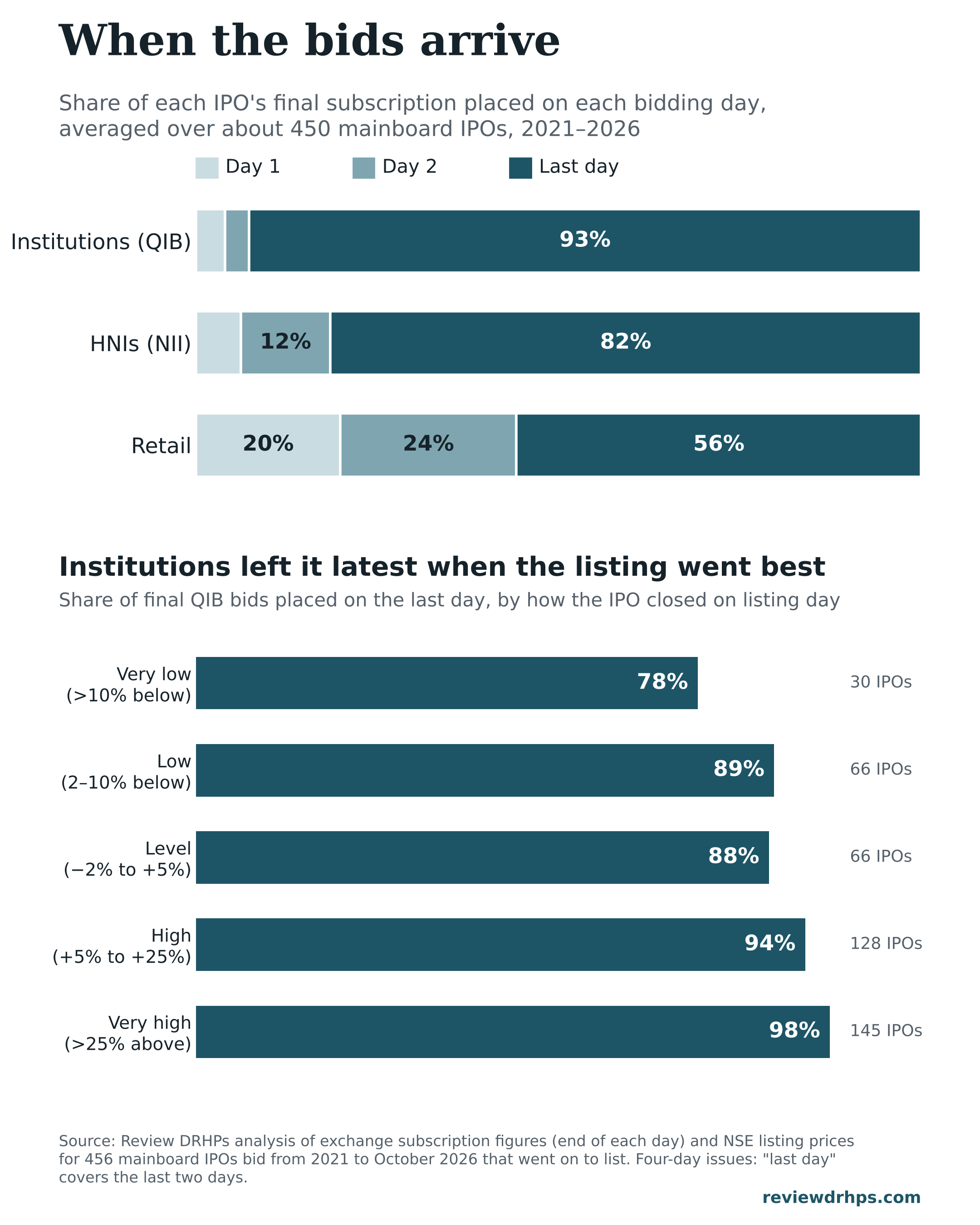
- Institutions place 93% of their bids on the last day, on average. HNIs place 82%. Retail investors spread theirs out: about a fifth on Day 1, a quarter on Day 2 and just over half on the last day.
- At the end of Day 2, the institutional quota was less than fully bid for in 64% of IPOs. More than half of those (55%) still ended with institutions bidding for over ten times their quota.
- The better the IPO went on to list, the later institutions bid. For IPOs that closed listing day more than 25% up, 98% of institutional bids came on the last day. For those that closed more than 10% down, it was 78%.
In other words, for two days the institutional figure tells a retail investor very little. The real institutional verdict arrives on the last day, and mostly in its last few hours.
One day up close: Jio Platforms
Jio Platforms' IPO closed on 23 October 2026. Timed updates published through that day show how the institutional figure moved:
| Time on the last day | Institutions (QIB) | HNIs (NII) | Source |
|---|---|---|---|
| 10:00 am | 13.31x | 6.74x | Groww |
| 3:00 pm | 32.77x | 13.38x | HDFC Sky |
| 3:18 pm | 35.43x | 13.56x | Choice India |
| 5:57 pm | 64.07x | 13.95x | Upstox |
| Final | 70.55x | 14.00x | Trendlyne |
The institutional figure almost doubled after about 3:15 pm, from 35 times to 70 times its quota. Much of that surge was visible only after bidding had closed for institutions, and the exchange totals kept updating into the evening.
Why the extra hour is hard to use
- Banks and brokers close earlier than the exchange. The exchange accepts retail bids until 5 pm, but banks and brokers set their own earlier cut-offs on the last day so they can block the money and send the bids on in time. Some banks stop taking IPO applications around 2 pm or 3 pm.
- The UPI step takes time. A bid placed through a broker app only counts once the investor approves the payment request on their phone, and that must happen by 5 pm.
- The figures arrive late. Exchange subscription pages refresh at intervals, and different pages refresh at different times. The near-final institutional figure may not be on screen until well after 4 pm.
- Institutions have done their homework. They have research teams who have read the offer document in full, and they have watched two days of retail and HNI demand before placing their own bids. Retail investors mostly have to decide without either.
Put together, only a retail investor using a broker app with UPI, watching the figures closely just after 4 pm, can really act on the institutional verdict. Most retail investors decide earlier, often on tips, reels or the grey market premium.
What retail investors can see earlier
Two official signals arrive well before the last afternoon.
- The anchor book. The day before an IPO opens, the company files the list of anchor investors: large institutions that commit at least ₹10 crore each and cannot sell for 30 to 90 days. Who they are, and how much of the book went to Indian mutual funds, is public from the first morning of bidding.
- The end of Day 2. Retail and HNI figures at the end of Day 2 are known on the morning of the last day. In our data, they give a useful early read at the extremes:
| Retail subscription at end of Day 2 | IPOs | Closed below issue price | Closed 25%+ up |
|---|---|---|---|
| Under 1x | 111 | 51% | 4% |
| 1–3x | 111 | 38% | 15% |
| 3–10x | 126 | 16% | 45% |
| Over 10x | 106 | 6% | 64% |
These are patterns across past IPOs, not predictions. The middle rows are close to a coin toss, and every year's market mood is different.
The rule that already exists
A wider gap is already allowed. Almost every offer document carries a clause like this one, from Crystal Crop Protection's red herring prospectus (page 8):
"Our Company in consultation with the BRLMs, may consider closing the Bid/Offer Period for QIBs one Working Day prior to the Bid/Offer Closing Date in accordance with the SEBI ICDR Regulations."
If it were used, institutions would have to finish bidding a full day before retail investors. Retail investors would then have a whole day, not a crowded hour, to see the institutional verdict before deciding. The clause is optional, and the choice rests with the company and its bankers.
The case for a wider gap
- Retail investors would see real institutional demand before deciding, instead of guessing.
- Institutions could no longer watch retail demand build for two days before showing their own hand.
- Fewer retail investors would need to rely on tips and reels in the last hours.
The case against
- Institutions might bid more cautiously, or push for a lower price, if made to commit a day early.
- The anchor book already gives an early institutional signal.
- Shares are ring-fenced by category, so a late institutional surge cannot take shares from the retail quota. The gap affects what retail investors know, not how many shares they get.
The extra hour exists on paper. In practice, institutions place almost all their bids on the last afternoon, and retail investors have little time, and often no figures, to respond. Until the timetable changes, the signals that arrive earlier, the anchor book and the end-of-Day-2 figures, are the ones retail investors can actually use, alongside the offer document itself.
This article is for information and education only. It is not investment advice or a recommendation to buy, sell or apply for any security, and past listings say nothing certain about future ones. Subscription figures are as published by the stock exchanges and reported by the sources below. Please read the offer document carefully and consult a SEBI-registered adviser before investing.
Sources
- Our analysis: end-of-day subscription figures by category (mostly from Trendlyne, with gaps filled from Chittorgarh, 5paisa, IPO Watch and others) and NSE listing-day prices for 456 mainboard IPOs bid from 2021 to October 2026. Averages exclude IPOs missing a Day 1 or Day 2 figure; for four-day issues, "last day" covers the last two days.
- Closing-day timings (4 pm for QIBs and NIIs, 5 pm for retail; UPI approval by 5 pm): SEBI's indicative timeline for T+3 listing, as reproduced by Union Bank of India
- Bank and broker cut-offs on the last day: m.Stock
- Jio Platforms, last day: 10:00 am, Groww; 3:00 pm, HDFC Sky; 3:18 pm, Choice India; 5:57 pm, Upstox; final, Trendlyne
- The clause on closing QIB bidding a day early: Crystal Crop Protection red herring prospectus dated 12 November 2026, page 8; see our Crystal Crop review
- Anchor investors: the ₹10 crore minimum, SEBI ICDR Regulations as summarised by TaxGuru; the 30- and 90-day lock-ins, Business Standard