The T+3 Effect: Do Day 3's Bids Show Up on Listing Day?
An IPO now lists three working days after bidding closes. In those three days, the institutions that bid on the last afternoon find out how few shares they got. What they do next can move the price. Here is how to read the official figures that show it, why they beat a sponsored reel, and what they cannot tell you.
Om Prakash Choudhary · 17 November 2026
Every big IPO now comes with a wave of short videos: "apply now", "sure-shot listing gains", "don't miss this one". Some are honest opinions. Some may be paid for by someone with an interest in the IPO doing well, and a 30-second reel rarely tells you which.
The rules recognise this risk. Since August 2024, SEBI has barred the firms it regulates, which include brokers, mutual funds and the merchant bankers who manage IPOs, from any direct or indirect association with unregistered people who give advice or make claims about returns on securities. A reel that sounds like a sales pitch deserves a second look.
There is a better place to look: what investors with real money at stake actually did.
What T+3 means
"T" is the day bidding closes. Since December 2023, SEBI has required every mainboard IPO to list within three working days of that day, down from six. Roughly: shares are allotted on T+1, credited and refunds made on T+2, and the shares start trading on T+3.
That short gap matters. Institutions place most of their bids on the last afternoon. On T+1 they learn how few shares they actually got. Two working days later, any institution that still wants the stock can only buy it on the exchange, on listing day. Tata Technologies and Hyundai both listed on T+3. Paytm, in 2021, listed on T+6 under the old rules.
Three buckets, plus the anchors
A mainboard IPO splits the shares on offer into three buckets. Usually 50% goes to institutions (Qualified Institutional Buyers, or QIBs: mutual funds, insurers, banks, foreign funds), 15% to non-institutional investors (HNIs, bidding more than ₹2 lakh) and 35% to retail investors. A company that has not been consistently profitable must keep 75% for institutions and can offer only 10% to retail; Paytm's IPO was split this way.
Before the IPO opens, the company can also sell part of the institutions' bucket to anchor investors.
What is the anchor book?
Anchor investors are large institutions, such as mutual funds, insurers, pension funds and foreign funds, that buy shares one working day before an IPO opens to everyone else. Each must put in at least ₹10 crore. They buy at a price inside the price band, usually the top. If the final IPO price is set higher, they pay the difference; if it is set lower, they get nothing back.
Their shares come out of the institutions' bucket, up to 60% of it. They cannot sell on listing day: half their shares are locked in for 30 days and the rest for 90 days. The company files the full list with the stock exchanges the evening before the IPO opens.
Read the percentages, not just the rupees. A big anchor figure usually just means a big IPO. Paytm's ₹8,235 crore was 45% of its IPO, Hyundai's ₹8,315 crore was 30%, and Tata Technologies' ₹791 crore was 26%. All three took the most the rules allowed for their size. What differed was who the anchors were: Indian mutual funds took 12.8% of Paytm's anchor shares, 34.4% of Hyundai's and 44.9% of Tata Technologies'.
Anchors are often brought in by the company's own merchant bankers, so a long list of names can make an IPO look more popular than it is. Paytm had India's largest anchor round at the time and still closed its first day 27% down.
During the three bidding days, the stock exchanges publish how many times each bucket has been subscribed. "2x" means investors in that bucket asked for twice the shares set aside for them.
What three IPOs show
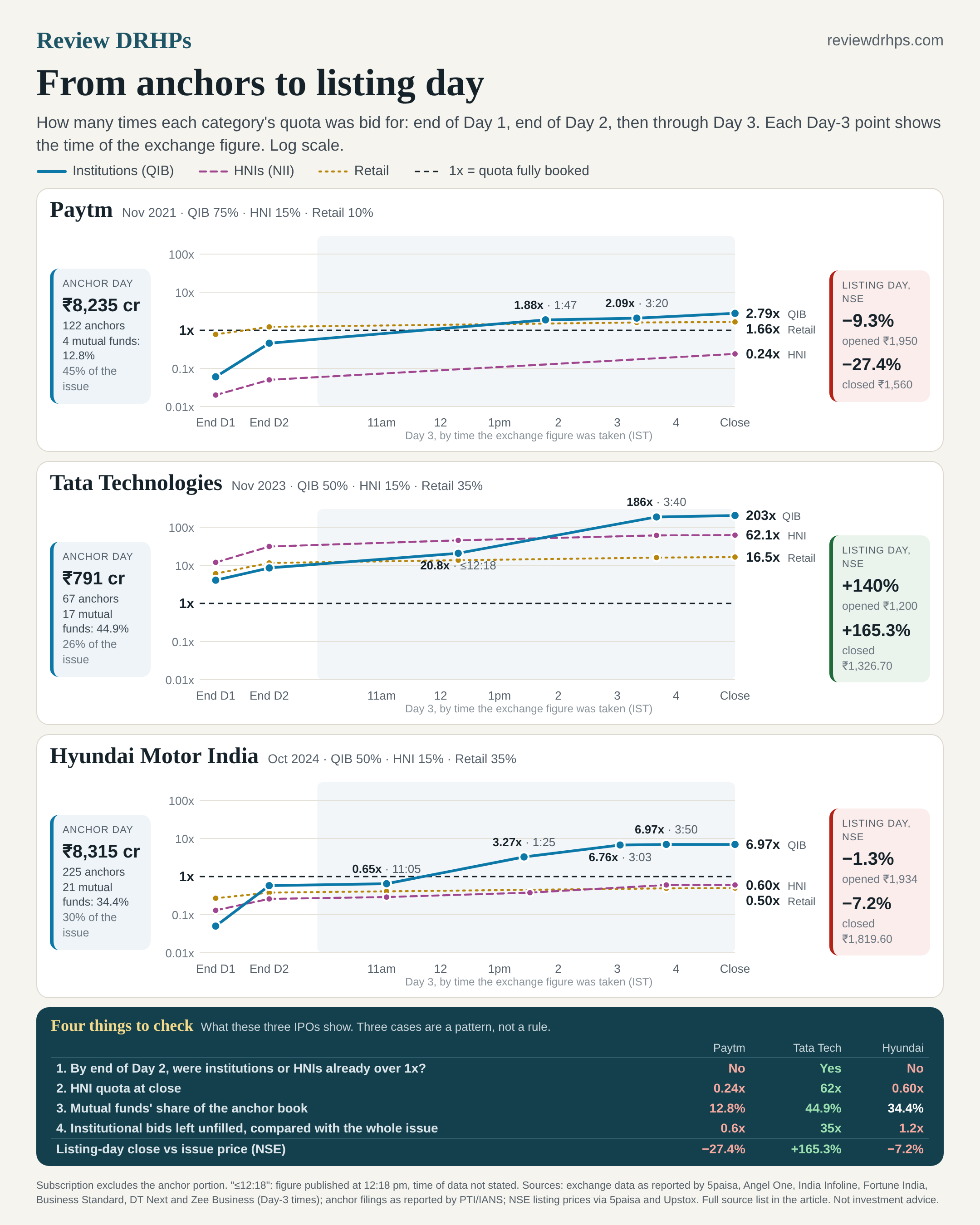
- Paytm (November 2021). Institutions had bid for less than half their bucket by the end of Day 2 (0.46x). They passed 1x on Day 3 (1.88x by 1:47 pm) and ended at 2.79x. HNIs never filled theirs (0.24x). Shares opened 9.3% below the issue price and closed their first day 27.4% below it.
- Tata Technologies (November 2023). Every bucket was full on Day 1. Institutions were at 8.55x by the end of Day 2, then rose to 186x by 3:40 pm on Day 3 and ended at 203x. HNIs ended at 62x and retail at 16.5x. Shares opened 140% above the issue price and closed 165.3% above it.
- Hyundai Motor India (October 2024). Institutions were at 0.65x at 11:05 am on Day 3, 3.27x by 1:25 pm and 6.97x by 3:50 pm. HNIs (0.60x) and retail (0.50x) never filled their buckets. Shares opened 1.3% below the issue price and closed 7.2% below it.
In all three, most of the institutions' bids came on the last afternoon. That is normal, so a low institutional figure on Day 1 or Day 2 is not, on its own, a bad sign.
The T+3 effect: why institutions' demand can matter on listing day
When institutions ask for many times the shares available, most of them get only a small part of what they wanted. Some may then buy on the stock exchange once the shares list, and that extra buying can push the price up in the first hours of trading. Studies of Indian IPOs have found that subscription by institutions is one of the factors linked to listing-day returns.
It is a tendency, not a rule. Hyundai is the reminder: institutions wanted almost seven times their shares, and the stock still listed below its price. The market on the day, the price the company set and how much the shares had already been talked up all matter too.
Four things to check
These are the figures that separated the one IPO that did well from the two that did not. Three IPOs are a pattern, not proof, so treat them as questions to ask, not a formula.
- By the end of Day 2, is the institutions' or the HNIs' bucket already full? Only Tata Technologies' was (institutions 8.55x, HNIs 31x). Paytm and Hyundai were both under 1x in both buckets. If you are deciding before Day 3 closes, this is the earliest real signal.
- Did the HNIs fill their bucket? HNIs often bid with listing-day gains in mind. Paytm's HNIs bid 0.24x and Hyundai's 0.60x; both fell on day one. Tata's bid 62x.
- How much of the anchor book went to Indian mutual funds? Paytm's was 12.8% (four fund houses), Hyundai's 34.4% and Tata Technologies' 44.9%. The company publishes this on the stock exchanges the evening before the IPO opens.
- How big is the institutions' unmet demand, compared with the whole IPO? Take the institutions' bids, subtract the shares they can get, and compare that with the size of the issue. For Tata Technologies it was about ₹1.07 lakh crore of unmet bids against a ₹3,043 crore IPO: 35 times the issue. For Hyundai it was about ₹33,000 crore against ₹27,870 crore (1.2 times), and for Paytm about ₹10,000 crore against ₹18,300 crore (0.6 times). Large institutions often bid for more than they expect to get, so read this as a rough size, not as money waiting to buy.
What demand cannot tell you
Subscription figures show how many people wanted the shares at that price in that week. They do not tell you what the business earns, what it owes, who is selling and why, or what could go wrong. A stock that lists well can fall later; one that lists badly can recover. For that, the only reliable source is the company's own prospectus.
Where to watch it
While an IPO is open, its review on Review DRHPs shows the exchange's own subscription figures for each bucket, with the time of each update, and the anchor book: how much the anchors put in, at what price, and how many were mutual funds. Official figures only, each with its source, and no grey-market premium. Beside them is the review itself: what the prospectus says, every point with its page.
This article is for information and education only. It is not investment advice or a recommendation to buy, sell or apply for any security, and past listings say nothing certain about future ones. Subscription figures are as published by the stock exchanges and reported by the sources below. Please read the offer document carefully and consult a SEBI-registered adviser before investing.
Sources
- Paytm, end of each day by category: IPO Watch; Day 3 at 1:47 pm: DT Next; Day 3 at about 3:20 pm: Zee Business; institutional bids and quota: 5paisa; anchor book: YourStory; listing day: 5paisa
- Tata Technologies, end of each day: 5paisa; Day 3 by 12:18 pm: India Infoline; Day 3 at 3:40 pm: India Infoline; institutional quota: IPOji; anchor book: Communications Today; listing day: 5paisa
- Hyundai Motor India, end of each day and institutional bids: 5paisa; Day 3 at 11:05 am: Angel One; at 1:25 pm: Fortune India; at 3:03 pm: Business Standard; at 3:50 pm: India Infoline; anchor book: IANS; listing day: Upstox
- Subscription and listing-day returns in India: Cogent Economics & Finance (2023)
- SEBI's rules on associating with unregistered finfluencers: Business Today
- Anchor shares as a share of each IPO: anchor allocations and issue sizes in the sources above; the ₹10 crore minimum per anchor: explainer
- T+3 listing, mandatory for IPOs opening on or after 1 December 2023: Business Standard; SEBI circular SEBI/HO/CFD/TPD1/CIR/P/2023/140 of 9 August 2023: LiveLaw
- Anchor investor lock-in: Upstox